COMPARISON LINE
Manual planning and configured planning, looked at plainly
Neither approach is presented as the obvious choice. This page sets out where each tends to work well and where the other still has the edge.
Back to home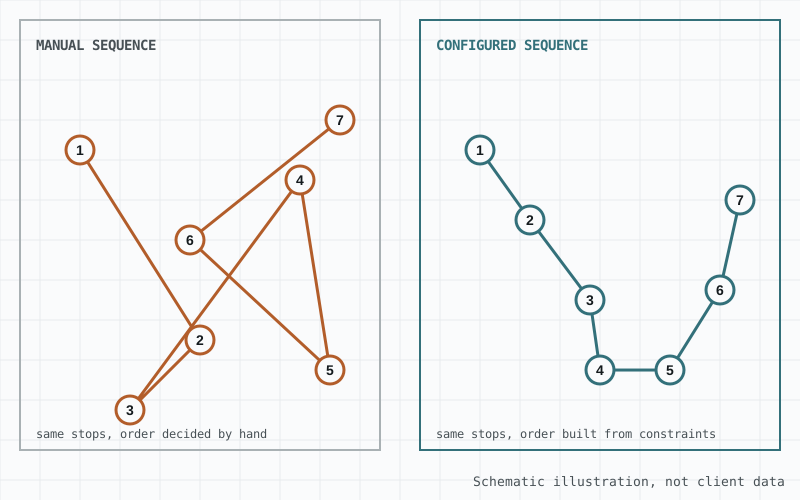
NODE 01 - WHY COMPARE
Different tools for different parts of the same job
Most dispatch teams already plan routes by hand, and often plan them well, using years of knowledge about particular streets and particular customers. A configured step does not replace that knowledge. It changes what the dispatcher starts from each morning.
The comparison below keeps to what can be said without measuring your fleet. Measured differences only appear in a review of your own records.
NODE 02 - SIDE BY SIDE
Manual planning versus a configured planning step
Manual planning
- Draws on a dispatcher's direct knowledge of streets and customers
- Adapts quickly to one unusual request
- Takes longer as the number of stops and vehicles grows
- Consistency depends on who is on shift
Configured planning step
- Produces a starting sequence from order data in minutes
- Applies the same constraints on every shift
- Still expects a dispatcher to review and adjust
- Needs a setup period to reflect local conditions
NODE 03 - OUR APPROACH
Configuration around your constraints, not a fixed template
We do not apply one general routing model. The setup starts from the four constraints on the home page (driver hours, vehicle capacity, agreed delivery windows and street access) and configures the planning step around those.
A dispatcher can override any suggested sequence. A day's local judgment, such as a road closure or a customer who called in, carries information that an order list does not.
NODE 04 - WHAT A REVIEW LOOKS FOR
Where the difference, if any, would show up
A utilisation review looks for journeys running well below capacity, routes that overlap between vehicles on the same day, and weekdays where fleet size and demand do not match. Some findings point at the planning step; others only need a schedule change on the planning board you already use.
Where a configured step is introduced, the month-one review compares it with earlier manual plans on equivalent days. We report what that comparison shows for your fleet, and we do not carry a figure over from anywhere else.
NODE 05 - WHAT THE FEE COVERS
Setup work, not a software licence
The fees on the offers page cover the configuration or review work itself: looking at your data, building constraints into the planning step, training dispatchers and the follow-up review. No ongoing software licence is bundled into the starting prices. Anything outside the scope in the written proposal would be agreed separately.
NODE 06 - OVER TIME
Neither approach is a one-time fix
Road works, seasonal demand and staff changes shift what a good plan looks like. A configured step needs a periodic look to stay useful, much as a hand-kept route book does. Likewise, manual planning is not inherently slow or careless; it simply takes more of the morning once a fleet grows.
If you are weighing the two
A fleet utilisation review on its own is the lightest way to see which parts of your current routine would gain most before you decide on anything else.
Read about the fleet utilisation review