FOUNDATION LINE
What guides how we set up route planning work
Our approach starts from the operational limits a plan has to respect, and treats the dispatcher's judgment as part of the system rather than something to be replaced by it.
Back to home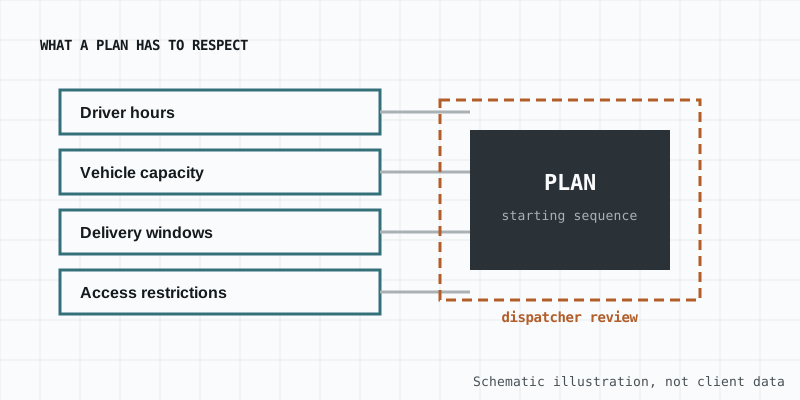
NODE 01 - FOUNDATION
Constraints come first
Before any distance or time figure is discussed we ask what a plan is not allowed to break: driver hours, load limits, agreed windows, street access. A shorter route that ignores one of them is not a usable plan, so the order of questions matters more than the algorithm.
NODE 02 - WHAT WE HOLD TO
Four working beliefs
Local records beat generic estimates
Your own journey history says more about your streets than a general map service does. We treat it as the first thing to read.
A plan should be adjustable, not final
Every configuration is built on the assumption that a dispatcher will override parts of it.
Access limits are routine
Narrow streets and residential access rules are an ordinary part of planning in many Japanese districts, not a rare exception.
Review after use beats modelling before use
A month of real operation tells us more about a setup than any amount of upfront modelling.
NODE 03 - IN PRACTICE
How this shows up in the work
Every engagement begins with a read of your order data and journey records before any configuration choice is made. Dispatcher training is a required step rather than an optional extra, and the month-one review is part of the scope instead of a courtesy call.
NODE 04 - AUTOMATION
Introduced where it earns its place
We are wary of adding automation for its own sake. A new step is proposed where a review has actually found something it would help with. Where manual planning already works for part of an operation, the review says so.
NODE 05 - STATING LIMITS
Being clear about what a plan can and cannot do
Arrival windows are shown with their reliability next to them, not as fixed promises. A configured sequence is a suggestion that the dispatcher checks against the rules that bind the carrier. No result is quoted in advance, because it depends on the fleet and the delivery area.
NODE 06 - WORKING TOGETHER
Alongside your dispatch team
The setup is done in contact with the people who will use it every morning. What dispatchers say during training and at the month-one review shapes the final configuration as much as the first data review does.
NODE 07 - LONG TERM
Conditions keep changing
Road access, customer agreements and fleet size all drift. A configuration that fits today may need another look in a year, so we describe the work as a starting point for a routine, not as a finished state. Whether to go ahead with any of it remains your decision.
Talk through your own constraints
A short description of your fleet and the way you plan today is enough to start a conversation.
Write to us